

You've heard the promise. AI will revolutionize manufacturing — predictive maintenance, automated quality control, real-time optimization. The technology exists. The models are available. So why do 95% of manufacturing AI projects fail to deliver measurable ROI?
After years of working with manufacturers across Germany and Europe, I can tell you with certainty: the problem isn't the model. The problem is everything around the model.
The Environment Wasn't Built for AI
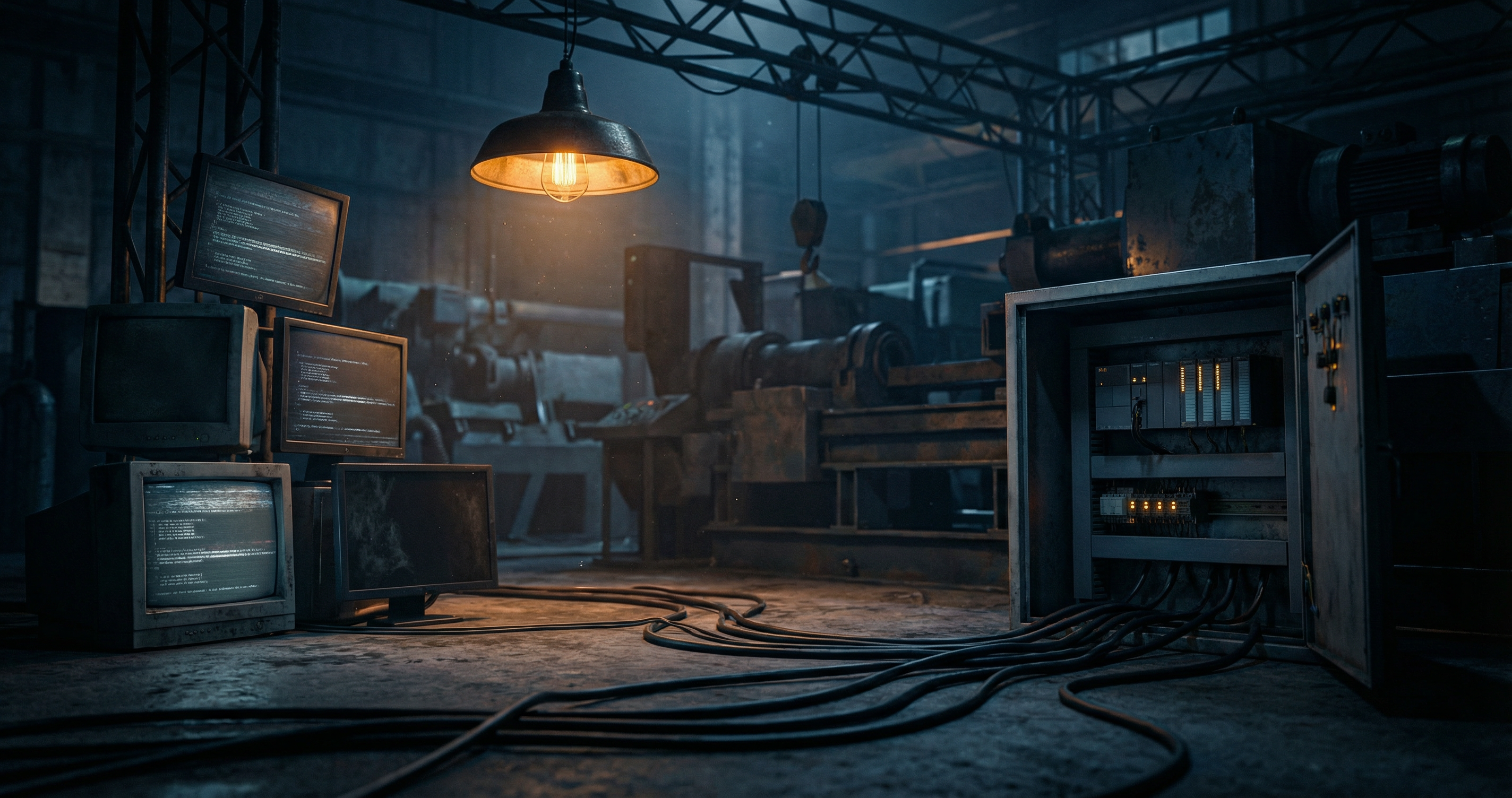
Manufacturing systems were designed for one thing: stability. Deterministic machine control. Isolated processes running reliably, shift after shift. They were never built with connectivity, structured data, or real-time analytics in mind.
What you actually find on a typical shop floor:
- Incompatible protocols across machines from different decades
- Legacy PLCs that speak proprietary languages
- Siloed MES systems with inconsistent data formats
- Missing timestamps, misaligned clocks between systems
- Vendor-locked APIs that require months to integrate
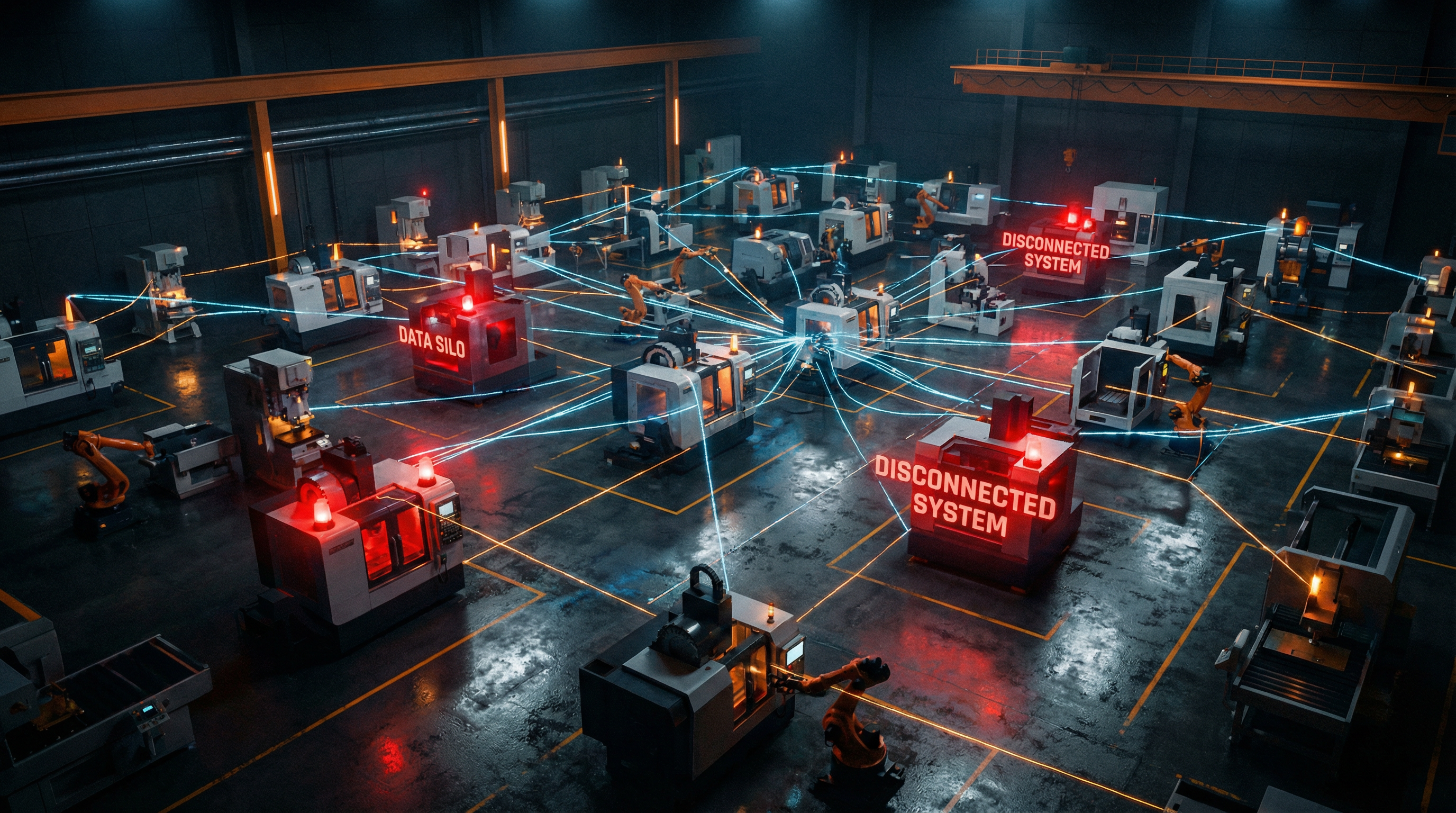
Each machine speaks its own language. Each production station produces data in its own way. Integrating these systems usually requires writing custom connectors, reverse-engineering machine interfaces, or dealing with vendor-specific APIs. This makes data access slow, brittle, and expensive.
The Data Quality Crisis
Even when data is accessible, it's rarely usable. Sensors measure physical signals, not process context. A temperature reading without knowing the operating mode, the material batch, or the tool condition is just noise that looks like data.
The problems compound:
- Sensor drift — signals change over time without anyone tracking it
- Time misalignment — PLCs, test machines, and MES platforms run on different clocks
- Missing labels — failures are rare, root causes unclear, quality outcomes delayed
- Context gaps — the same signal means different things during startup vs. steady-state production
AI models depend on clean, synchronized, contextualized data. Most factories simply cannot provide this without substantial preprocessing work.
Every Use Case Becomes Its Own IT Project
Here's where the economics break down. For every AI use case, teams need to build:
- A new data pipeline
- A new preprocessing workflow
- A new deployment mechanism
- New integration logic with MES or operator dashboards
This means every use case is essentially a bespoke IT project. No wonder most companies never move beyond isolated pilots — the architecture simply doesn't scale.
"95% of AI pilots or enterprise AI projects fail to deliver measurable ROI or significant business impact. Only about 5% of these projects successfully scale and produce measurable value."
— MIT, "The GenAI Divide: State of AI in Business 2025"
The Human Factor Nobody Talks About
Manufacturing has unique constraints that consumer AI never has to deal with: high uptime requirements, strict safety rules, full traceability, and the need for operator oversight. AI cannot simply "take over" decisions. It must support people, not replace them.
But in many AI projects, this requirement is handled too late — or not at all. The result? Mistrust and resistance on the shop floor. Operators who don't understand why a system behaves a certain way will find ways to work around it.
What Actually Works
The solution isn't better algorithms. It's a better foundation.
At RockQ, we've built a no-code platform with an integrated Machine Learning Studio that attacks the biggest blockers first:
1. Remove Integration Complexity
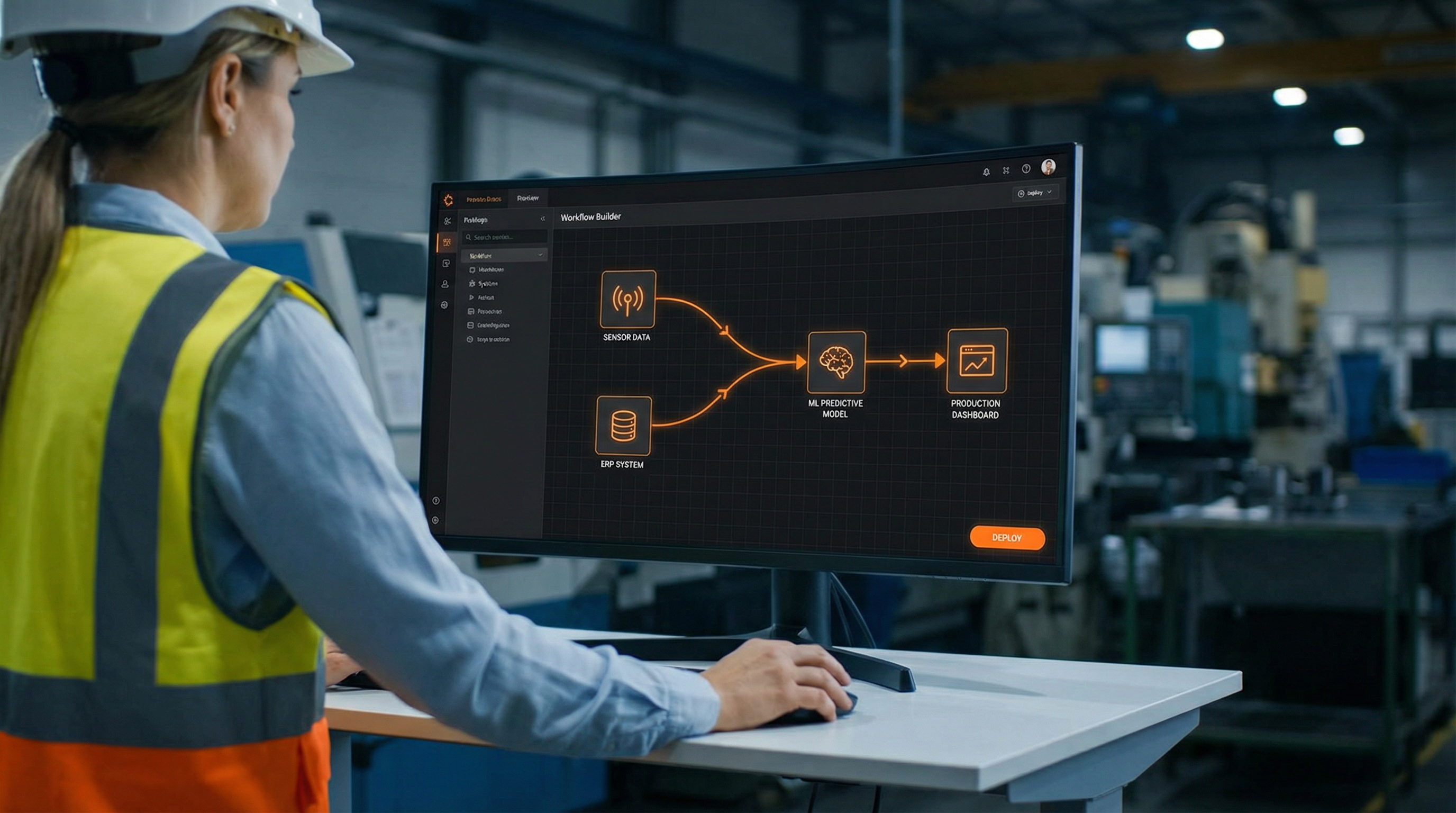
Our platform connects any machine, PLC, or IT system without writing custom drivers. OPC UA, MQTT, legacy controllers, test machines, MES databases — all normalized into a unified data layer. This eliminates months of connectivity work that typically precedes any AI effort.
2. Fix Data at the Source
The ML Studio lets process engineers — the people who actually understand the machines — clean, label, and prepare data visually. They remove noise, align timestamps, and add process context. The model finally learns from the correct representation of the process, not from raw chaotic logs.
3. Train and Deploy in One Environment
Model training happens inside the same platform. AutoML or custom training pipelines run without exporting data or switching tools. The platform evaluates performance, selects the best model, and packages it for deployment — all in one flow.
4. Make AI Operational, Not Experimental
Deployment is not a separate engineering project. With drag-and-drop logic blocks, models connect to real-time data, dashboards, alerts, and operator workflows. The entire path — from signal to prediction to action — becomes transparent. Operators keep full control.
5. Scale Without Rebuilding
Because all use cases share the same infrastructure, companies don't rebuild pipelines for each new project. Connectors, logic blocks, and data sources are reused across the entire factory. This is what turns AI from a collection of isolated PoCs into a scalable capability.
The Bottom Line
Manufacturing AI doesn't fail because the technology isn't ready. It fails because the environment isn't ready. Fix the data access, fix the data quality, fix the integration, fix the deployment — and even simple models deliver consistent ROI.
The question isn't whether AI works in manufacturing. It's whether your factory is ready for it.