

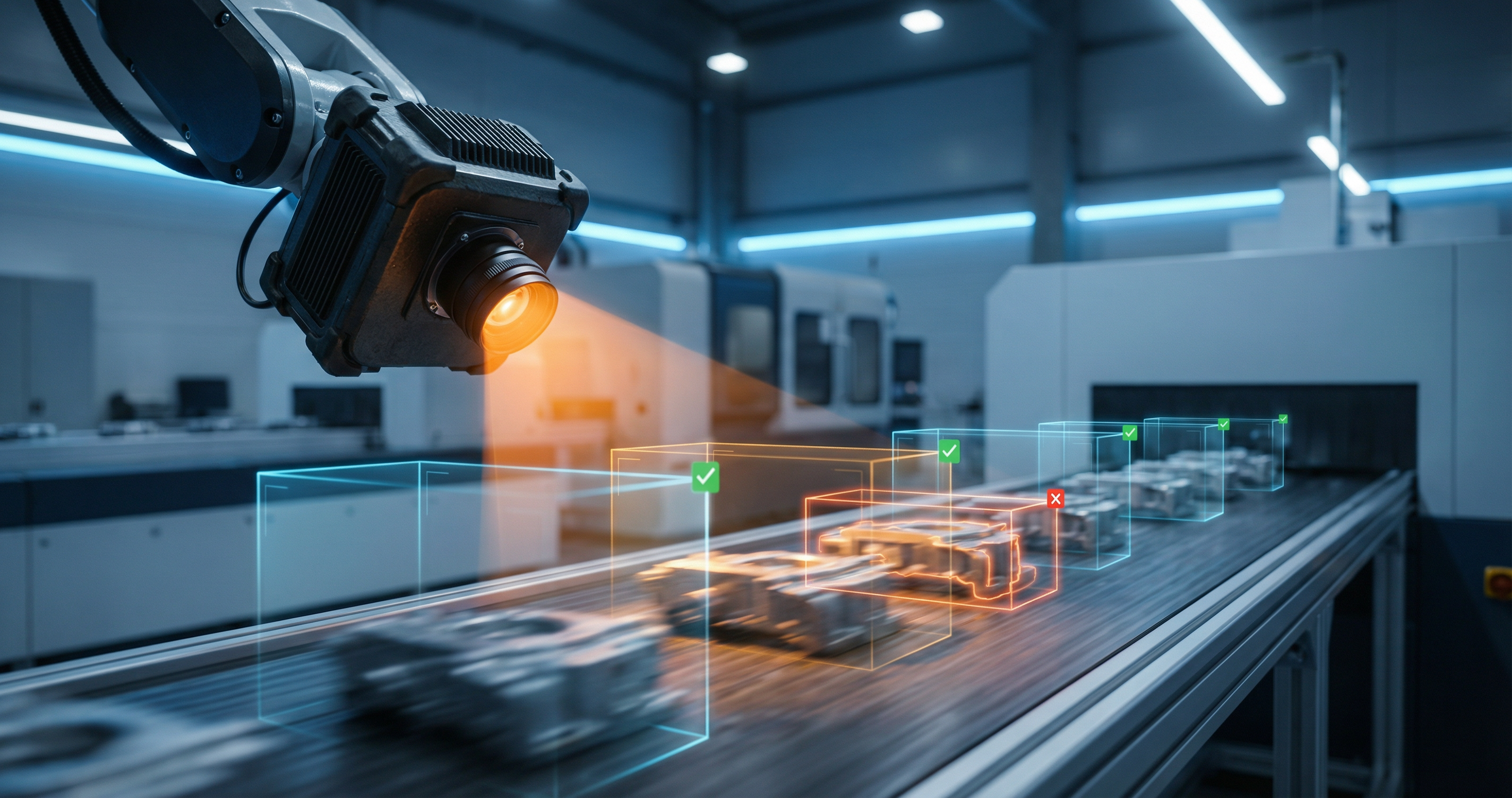
A trained quality inspector can spot a surface scratch, a misaligned weld, or a discolored component in seconds. The problem isn't skill — it's scale. When a production line runs at 120 parts per minute, no human can maintain that level of attention for an entire shift. Fatigue sets in after the first hour. By the fourth hour, defect escape rates climb noticeably. By the eighth hour, inspection is largely performative.
This isn't a criticism of people. It's a statement about the physical limits of human visual processing under sustained repetition. Manufacturing has known this for decades. The response has been sampling — inspect every tenth part, every hundredth part, and accept the statistical risk. But in industries like automotive, medical devices, and electronics, even a small number of escaped defects can mean recalls, warranty claims, or regulatory action.
What Camera-Based AI Inspection Actually Does
AI-powered visual inspection uses industrial cameras — area scan, line scan, or 3D — combined with trained deep learning models to classify every part at production speed. Unlike rule-based machine vision, which requires hand-coded thresholds for every defect type, deep learning models learn what "good" and "bad" look like from labeled examples. This makes them far more adaptable to the variability you see on a real production line: lighting shifts, material batch differences, tool wear progression.
The typical architecture looks like this:
- Image acquisition — cameras triggered by sensors or encoders capture each part at a fixed station
- Preprocessing — images are cropped, normalized, and aligned to a reference frame
- Inference — the trained model classifies the image (pass/fail, defect type, severity) in milliseconds
- Action — results trigger sorting mechanisms, operator alerts, or MES quality records
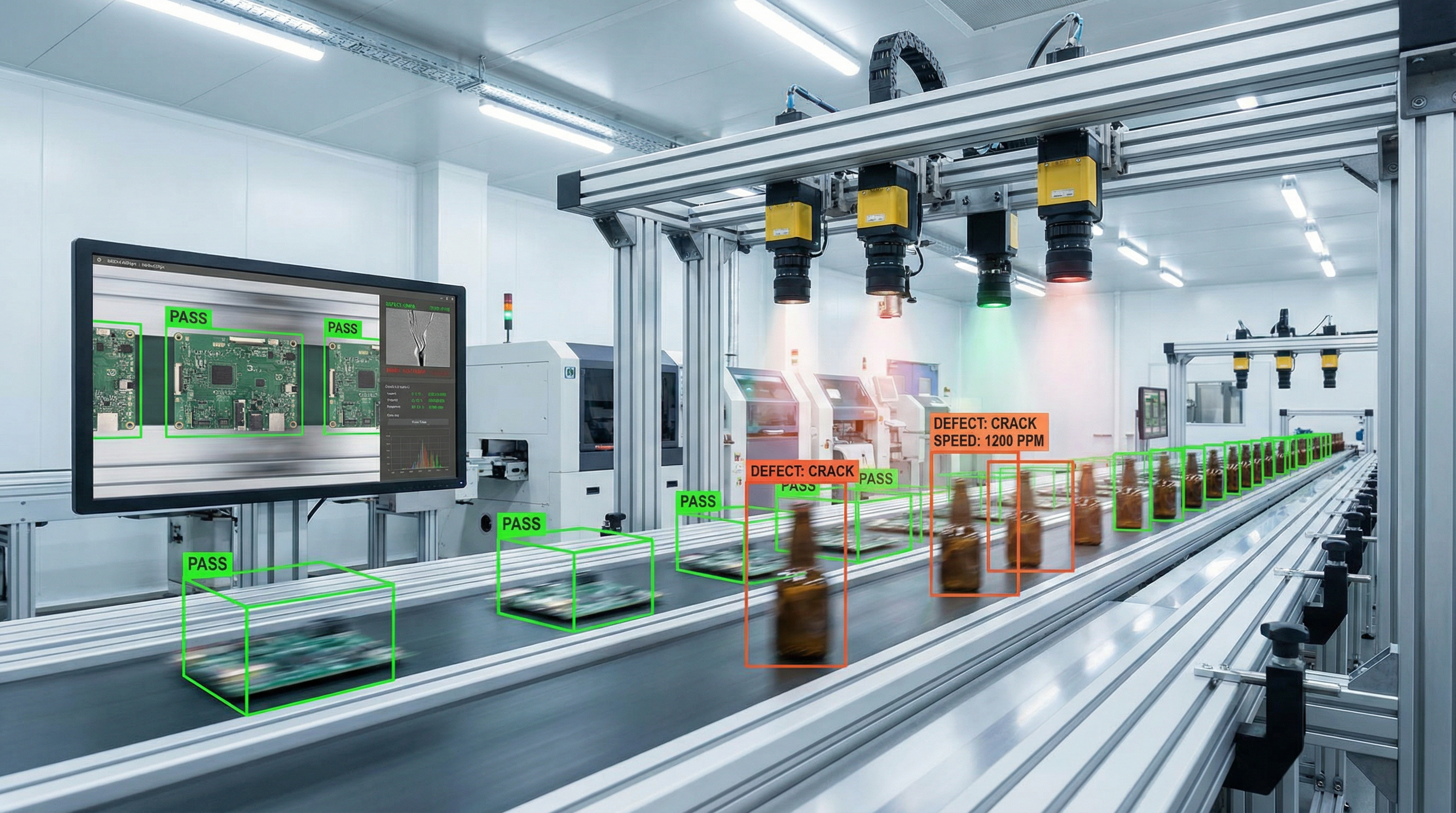
The inference step is where deep learning separates itself from traditional machine vision. A conventional system needs explicit rules: "if scratch length > 2mm and depth > 0.1mm, reject." A deep learning model learns these boundaries implicitly from hundreds or thousands of labeled images. It generalizes across defect variations that would require an impractical number of hand-coded rules.
Training Models on Real Defect Data
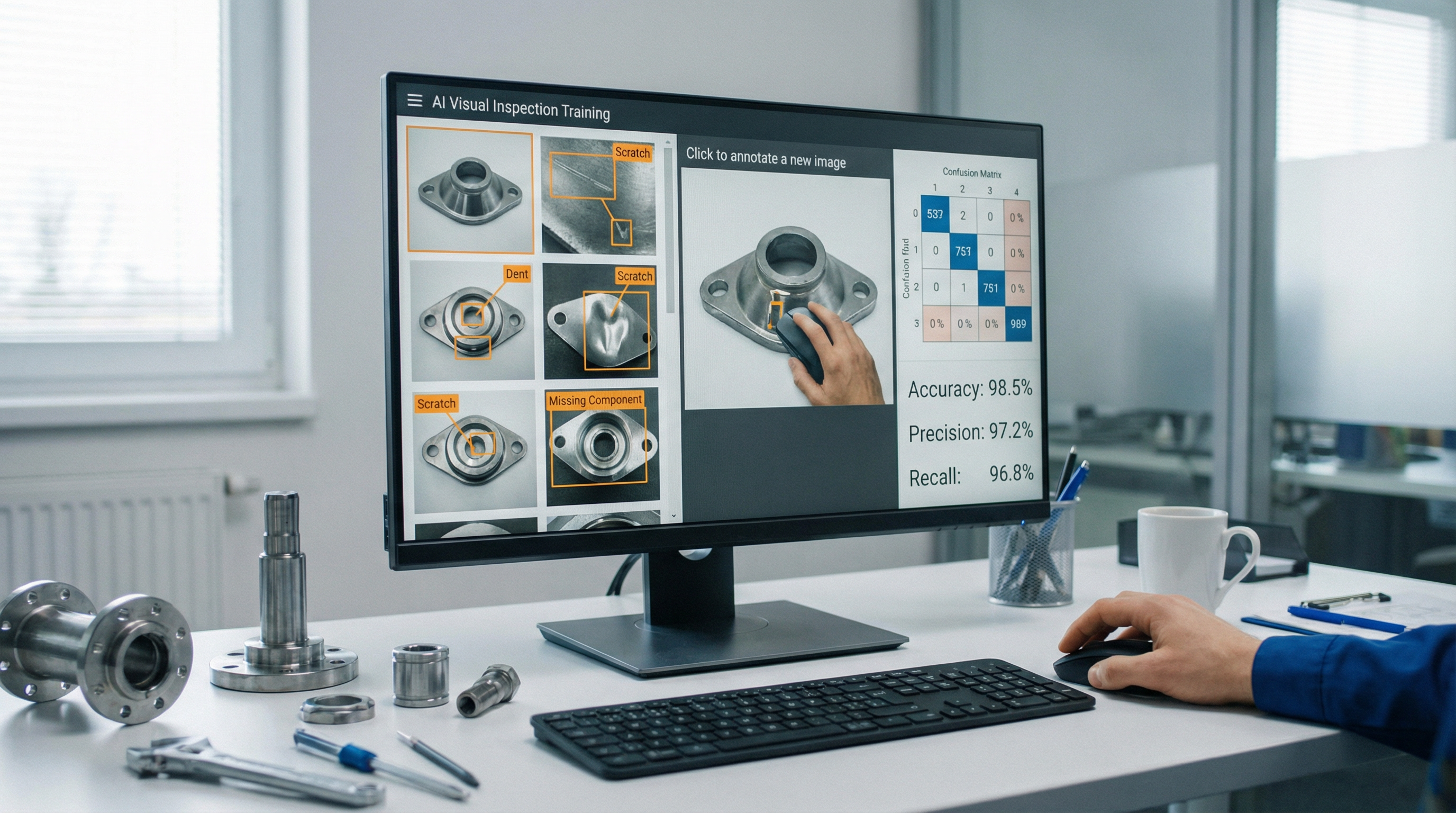
The quality of a visual inspection model depends entirely on the quality of its training data. This is where most projects hit their first real obstacle. Defects are, by definition, rare events. A well-running production line might produce 0.1% defective parts. That means for every 1,000 images of good parts, you might have one image of a scratch, one of a dent, none of a crack. Building a balanced training dataset requires deliberate effort: collecting defect images over weeks or months, augmenting them with rotations and lighting variations, and having domain experts label them precisely.
In RockQ's ML Studio, this labeling and training workflow happens visually. Process engineers and quality specialists — the people who actually know the difference between a cosmetic mark and a functional defect — annotate images directly in the platform. They define defect categories, draw bounding boxes or segmentation masks, and train models without writing code. The model evaluates on held-out test data, and engineers review the confusion matrix to understand exactly where the model struggles before it goes anywhere near the production line.
Deploying on the Line and Connecting to MES
A model that works in the lab but can't run at line speed is useless. Deployment means the model runs inference within the cycle time of the production process — often under 100 milliseconds. It means the system handles camera failures gracefully, logs every decision for traceability, and integrates with the MES so that quality data flows into the same system operators and quality managers already use.
This last point — MES integration — is frequently underestimated. An AI inspection system that exists in isolation creates a parallel data silo. Operators check one screen for production data and another for inspection results. Quality managers can't correlate defect trends with batch data or process parameters. The real value emerges when inspection results are written back into the MES as structured quality events: defect type, location, timestamp, associated batch, and linked process conditions. That's when visual inspection becomes not just a gatekeeper, but a source of continuous process intelligence.
Visual quality inspection AI isn't about replacing inspectors. It's about giving every single part the same level of scrutiny that the best inspector delivers on their best day — consistently, at full speed, shift after shift. The technology is mature. The challenge is deploying it in a way that respects manufacturing workflows, connects to existing systems, and puts domain expertise at the center of the process.