

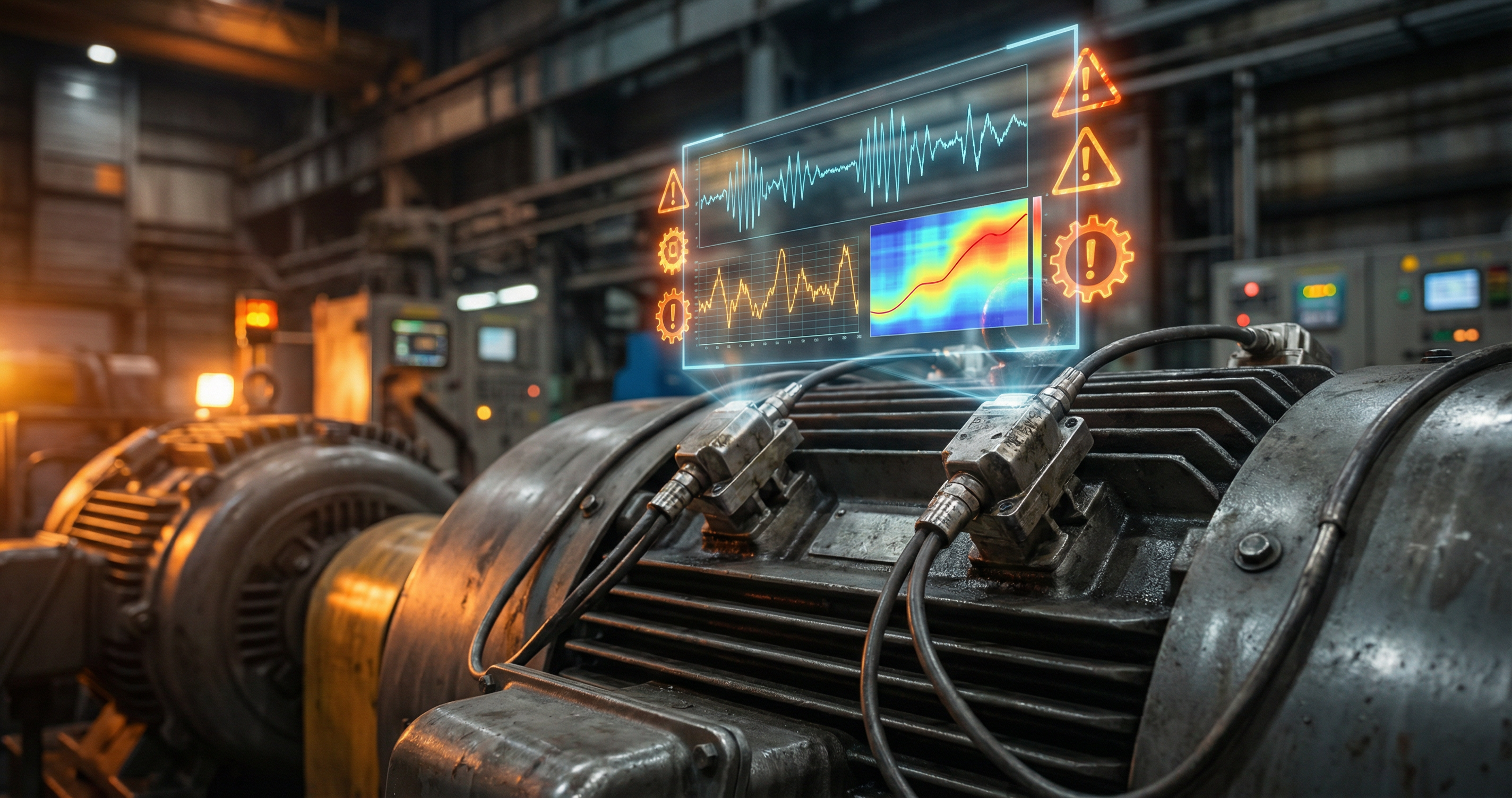
Most factories still maintain their equipment in one of two ways: they run it until it breaks, or they service it on a fixed calendar regardless of actual condition. Both approaches cost more than they should. Reactive maintenance means unplanned downtime, emergency spare parts, and cascading production delays. Calendar-based maintenance means replacing components that still have months of useful life, pulling machines offline during peak demand, and spending labor hours on interventions that weren't necessary.
Predictive maintenance offers a fundamentally different model. Instead of reacting to failure or guessing when it might happen, you monitor the actual condition of the equipment in real time and intervene only when the data indicates a problem is developing. The concept isn't new — condition monitoring has existed for decades. What's changed is the ability to process high-frequency sensor data with machine learning models that detect subtle degradation patterns long before they become visible to an operator or a threshold-based alarm.
From Reactive to Predictive: Three Maintenance Models
Understanding where predictive maintenance fits requires seeing the full spectrum. Reactive maintenance — "run to failure" — is the simplest strategy. You operate equipment until something breaks, then fix it. For non-critical assets, this can be acceptable. For a spindle on a high-value CNC machine or a bearing in a continuous process line, unplanned failure means hours of downtime, potential damage to the workpiece, and a ripple effect across downstream operations.
Time-based preventive maintenance improves on this by scheduling interventions at fixed intervals: every 500 operating hours, every 90 days, every 10,000 cycles. This reduces surprise failures but introduces a different kind of waste. Studies consistently show that 30-40% of time-based maintenance activities are performed too early, replacing components that had significant remaining useful life. Worse, fixed schedules can miss rapidly developing failures that occur between service windows.
- Reactive — lowest planning cost, highest failure cost, unpredictable downtime
- Time-based preventive — moderate cost, over-maintenance, still misses some failures
- Predictive (condition-based) — optimal timing, minimal unnecessary work, early warning of developing faults
Vibration Analysis and Anomaly Detection
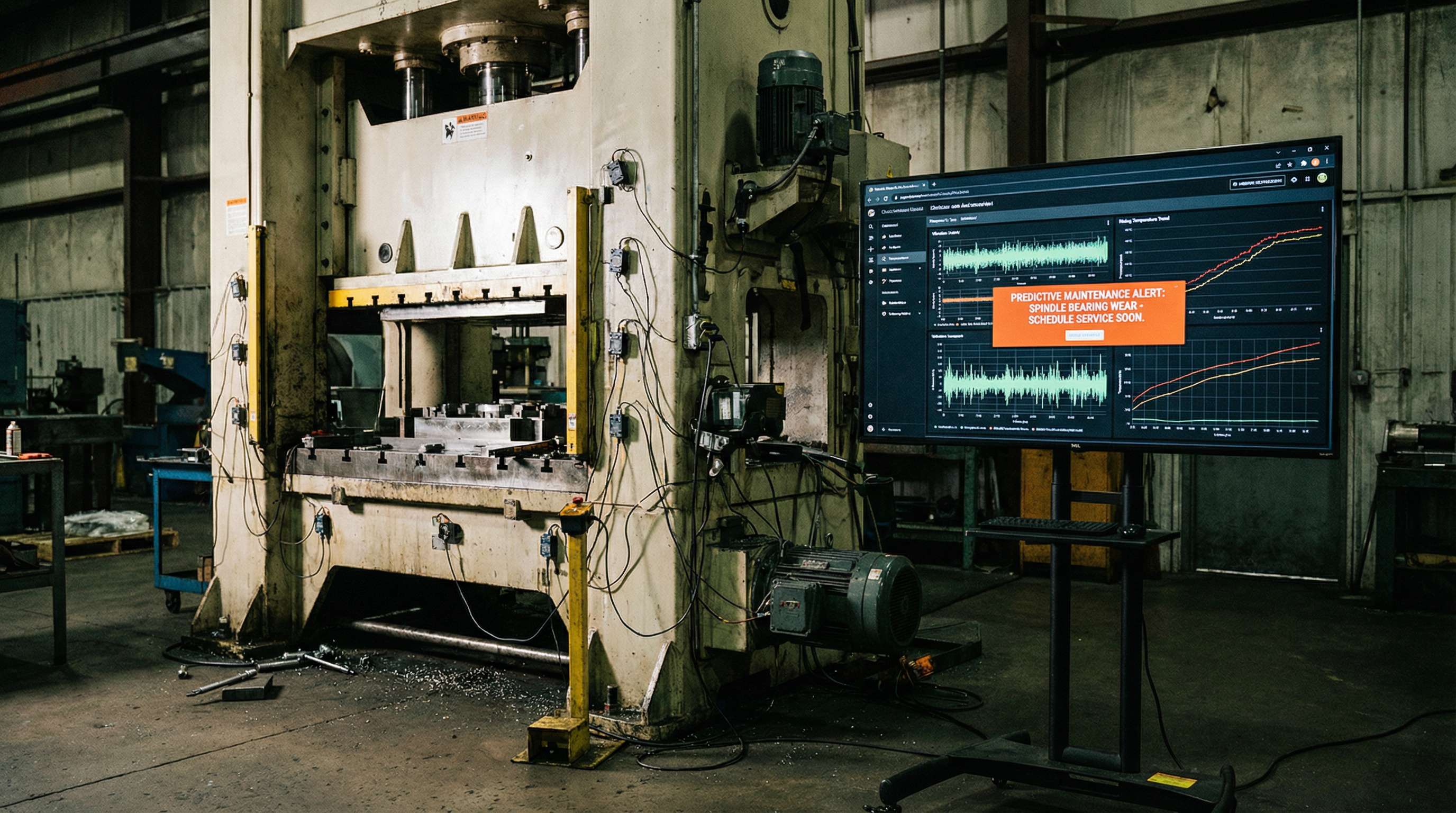
Vibration is the most information-rich signal available for rotating equipment — motors, spindles, bearings, gearboxes, pumps. A healthy bearing produces a consistent vibration signature. As wear progresses, new frequency components appear. A developing inner race fault, for instance, introduces a characteristic frequency that grows in amplitude over time. Traditional vibration analysis required specialists to interpret FFT spectra manually. Machine learning automates this: models learn the normal vibration profile of a machine under various operating conditions and flag deviations that correlate with known failure modes.
But vibration is just one signal. Effective predictive maintenance combines multiple data streams: vibration, temperature, current draw, acoustic emission, pressure differentials, and operating parameters from the PLC. The power of a machine learning approach is that it can fuse these signals and detect multivariate patterns that no single-threshold alarm would catch. A slight increase in motor current combined with a shift in vibration frequency and a 2°C temperature rise might individually mean nothing — but together, they indicate bearing degradation with high confidence.
In RockQ's ML Studio, engineers build these anomaly detection models visually. They select the relevant sensor channels, define the normal operating envelope from historical data, and train models that score each time window against learned baselines. The platform handles the signal processing — resampling, alignment, feature extraction — so the engineer focuses on what matters: understanding the machine behavior and validating that the model captures real degradation, not noise.

Connecting to CMMS and Measuring OEE Impact
A predictive model that generates alerts nobody acts on is a science project, not a maintenance tool. The critical last mile is integration with the Computerized Maintenance Management System (CMMS). When the model detects an anomaly above a configured threshold, it should automatically create a work order with the relevant context: which machine, which component, what the model detected, what sensor data supports the prediction, and a recommended action window. Maintenance planners then schedule the intervention during the next planned downtime instead of reacting to an emergency.
The impact on Overall Equipment Effectiveness (OEE) is where predictive maintenance justifies its investment. OEE captures availability, performance, and quality in a single metric. Predictive maintenance directly improves the availability component by converting unplanned stops into planned ones. But the effects go further. Machines that operate within healthy parameters produce more consistent quality. Operators who trust the monitoring system don't compensate by running equipment at reduced speed "just in case." The compounding effect on OEE is typically 5-15 percentage points — and in high-value continuous processes, even a single percentage point of OEE improvement translates to significant revenue.
Predictive maintenance isn't about eliminating all maintenance. It's about eliminating the wrong maintenance — the emergency calls at 2 AM, the unnecessary shutdowns during peak production, the components replaced six months too early. When you let the machine tell you what it needs, through data rather than guesswork, maintenance becomes a strategic function instead of a cost center.