

The average manufacturing AI pilot takes six to twelve months. Most never reach production. The model works in the lab, the demo impresses leadership, and then the project enters a slow death spiral of integration challenges, deployment delays, and shifting priorities. By the time the team resolves the infrastructure issues, the business case has changed or the budget has moved elsewhere.
This pattern is so common that many manufacturers now assume AI projects simply take a long time. They shouldn't. When the right infrastructure exists, moving from concept to production in six weeks is not only realistic — it's repeatable. The bottleneck was never the model. It was everything around it.
Why AI Pilots Stall
To understand the six-week timeline, you first need to understand where the time actually goes in a typical project. Break down any manufacturing AI pilot and you'll find a consistent pattern:
- Weeks 1–6: Getting data access — negotiating with IT, finding the right PLC registers, writing custom connectors, dealing with firewall rules
- Weeks 7–12: Data engineering — cleaning sensor data, aligning timestamps, building a preprocessing pipeline, dealing with missing values and format inconsistencies
- Weeks 13–16: Model development — the actual AI work, which typically takes a fraction of the total timeline
- Weeks 17–24: Deployment — setting up inference servers, connecting to dashboards, integrating with operator workflows, handling edge cases
The model development — what most people think of as the AI project — occupies about four weeks in the middle. Everything else is infrastructure. And that infrastructure is rebuilt from scratch for every single pilot. This is why projects drag on. Not because the AI is hard, but because the plumbing is.
The Six-Week Framework
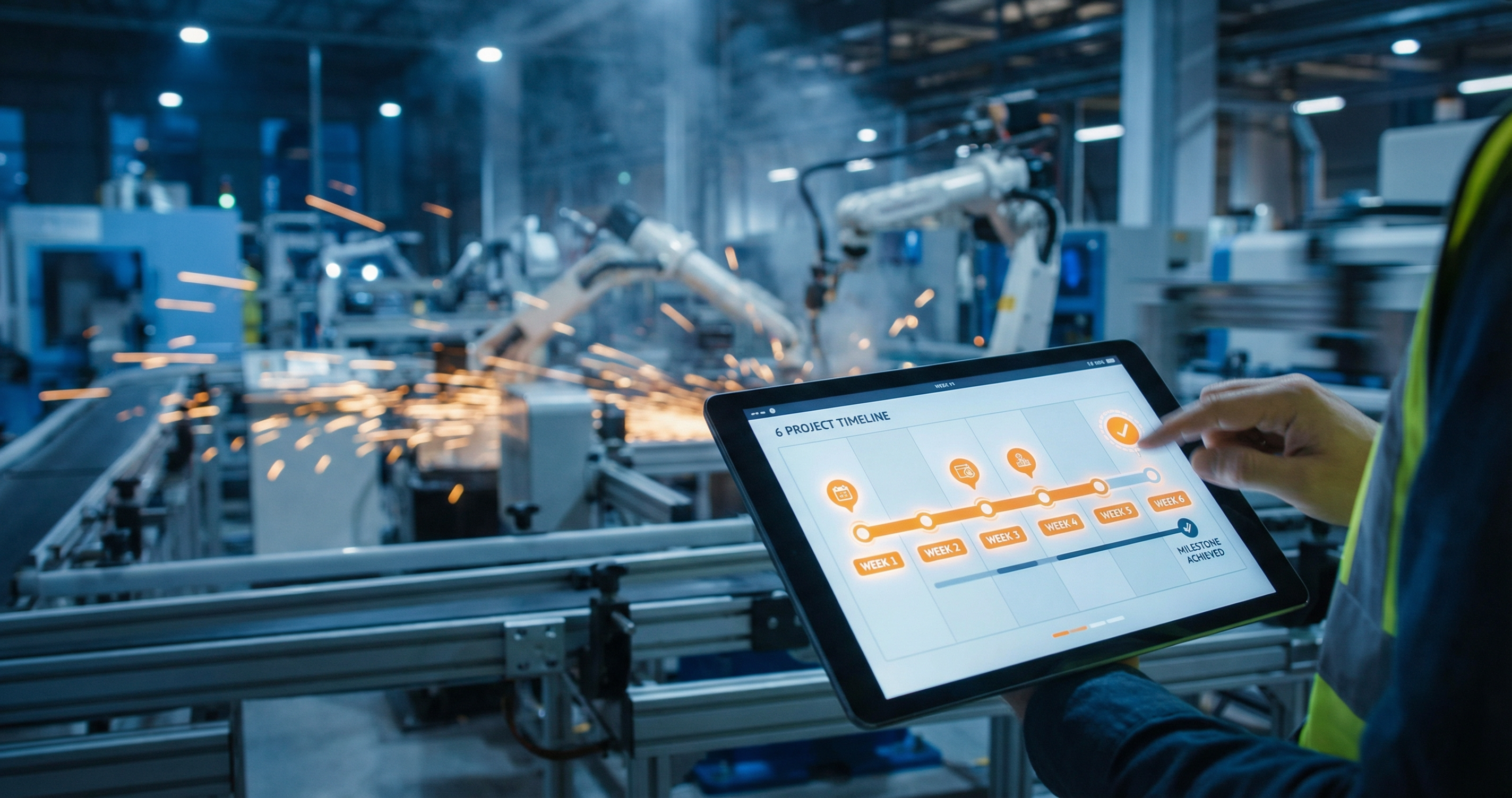
When shared infrastructure already exists — machine connectivity, a unified data layer, deployment pipelines, operator interfaces — the timeline compresses dramatically. Here's what a realistic six-week manufacturing AI project looks like:
Week 1: Scope and Signal Mapping. Define the specific production problem, identify the relevant machine signals, and verify data availability. On a platform with existing connectors, this is configuration, not development. The team maps signals to the use case and confirms data quality within days.
Week 2: Data Preparation and Feature Engineering. Process engineers — the people who understand the machines — use the platform's visual tools to clean data, remove outliers, align time windows, and create derived features. No coding required. No handoff to a data engineering team. The domain expert works directly with the data.
Weeks 3–4: Model Training and Validation. Using the integrated ML Studio, the team trains models against prepared datasets. AutoML handles hyperparameter tuning and model selection. Process engineers validate results against their domain knowledge — does the model's behavior match what they know about the process? Iterations happen in hours, not weeks.
Week 5: Deployment and Integration. The validated model connects to live production data through the same platform. Drag-and-drop logic blocks wire the model's output to dashboards, alert systems, and operator workflows. There's no separate deployment engineering phase because the training environment and the production environment are the same platform.
Week 6: Monitoring, Tuning, and Handover. The team monitors model performance against live data, adjusts thresholds based on operator feedback, and documents the operational workflow. By the end of week six, the use case is running in production with full operator oversight.
Shared Infrastructure Is the Multiplier
The reason this timeline is possible is not speed — it's elimination. The six-week framework doesn't do the same work faster. It removes the work that shouldn't exist in the first place. Machine connectivity is already solved. Data normalization is already in place. Deployment pipelines already exist. The team focuses entirely on the use case itself.
This has a compounding effect. The first use case on a new platform might still require some initial setup — connecting machines, configuring data sources. But the second use case on the same line benefits from everything already built. By the third or fourth use case, teams routinely deploy in two to three weeks. The infrastructure investment pays dividends across every subsequent project.
Manufacturing AI doesn't need to be a multi-quarter endeavor. When the foundation is right, six weeks from problem statement to production deployment is the standard — not the exception. The question for manufacturers isn't whether this pace is achievable. It's how much longer they're willing to accept the alternative.